
How Much Does It Cost to Manufacture a Diaper?
A medium-size taped baby diaper can cost approximately US$0.10 per acceptable piece, including materials, packaging, labor, utilities and equipment depreciation.
The actual cost changes with diaper size, material specifications, rejected output and monthly production volume. To compare costs accurately, manufacturers need to calculate them against the same product requirements and the number of diapers that pass inspection.
What Costs Are Included in Diaper Manufacturing?
Diaper manufacturing cost includes consumed raw materials, packaging and factory operating expenses allocated to each acceptable diaper.
Raw materials include fluff pulp, superabsorbent polymer (SAP), nonwovens, backsheet film, elastics, fastening parts and adhesives. Factory expenses include labor, quality control, electricity, compressed air, maintenance, premises and equipment depreciation. Outbound shipping, marketing, sales fees and profit margin are separate from manufacturing cost.
Cost per acceptable diaper = total manufacturing expenses ÷ acceptable diapers produced. Using acceptable output as the denominator accounts for the effect of rejected products on unit cost.
How Much Do Raw Materials Cost Per Diaper?
A medium-size taped diaper using the quantities and prices below consumes US$0.0770 of materials per diaper started, or US$0.0794 per acceptable diaper at a 97% acceptance rate.
For materials sold by weight, multiply grams consumed per diaper by the delivered price per kilogram, then divide by 1,000. Material consumption should include normal cutting trim and process use. The prices in this calculation are planning assumptions to be replaced with supplier quotations.
| Material | Consumption per diaper started | Assumed delivered price | Cost per diaper started |
|---|---|---|---|
| Fluff pulp | 11 g | US$1.20/kg | US$0.0132 |
| SAP | 8 g | US$1.90/kg | US$0.0152 |
| Nonwovens for the topsheet, acquisition layer, core wrap and covers | 14 g | US$2.10/kg | US$0.0294 |
| Backsheet film | 4 g | US$2.00/kg | US$0.0080 |
| Elastics, tapes and hot-melt adhesives | Combined allowance | — | US$0.0112 |
| Total material cost | US$0.0770 | ||
Material weight and price can be adjusted for a specific product using DanE’s cost calculator. Its material-cost result must be combined with packaging, production losses and factory expenses to obtain the complete manufacturing cost.
How Do Rejected Diapers Affect the Cost Per Piece?
Rejected diapers raise the material cost per acceptable diaper because the materials consumed by rejected products must be covered by the output that can be sold.
With a US$0.0770 material bill and a 97% acceptance rate, material cost per acceptable diaper is US$0.0770 ÷ 0.97 = US$0.0794. At a 90% acceptance rate, it rises to US$0.0856. That difference adds approximately US$6.17 in material cost per 1,000 acceptable diapers.
Actual monthly material spending divided by actual acceptable output already includes production losses. Do not apply an additional rejection allowance to that result.
What Is a Complete Cost Breakdown for One Baby Diaper?
The diaper described above costs approximately US$0.1034 per acceptable piece after packaging and factory expenses are added to its material cost.
This calculation uses a running speed of 300 diapers per minute, one eight-hour shift on 22 days per month, 85% running time and 97% acceptance. Those conditions produce 2,612,016 acceptable diapers per month. Packaging is assumed to cost US$0.28 per pack of 40, or US$0.0070 per diaper.
| Cost item | Cost per acceptable diaper |
|---|---|
| Materials, including rejected diapers | US$0.0794 |
| Packaging | US$0.0070 |
| Labor and quality control | US$0.0060 |
| Utilities | US$0.0020 |
| Maintenance | US$0.0020 |
| Equipment depreciation | US$0.0038 |
| Premises and other factory overhead | US$0.0032 |
| Total, rounded | US$0.1034 |
Factory expenses in this calculation total an assumed US$44,400 per month. They include US$10,000 of monthly depreciation, equivalent to allocating US$600,000 of equipment cost over five years. Using unrounded figures, the complete manufacturing cost is US$0.10338 per diaper, or US$103.38 per 1,000.
Why Do Different Diapers Cost Different Amounts to Make?
Diapers cost different amounts to make because their size, absorbent core, fit features and production processes require different materials and operating conditions.
A larger diaper generally consumes more material than a smaller one. Pull-up pants require a different waistband and assembly process from taped diapers. Features such as wetness indicators, softer covers and more complex fastening systems add components or processing steps. Calculate each size and design separately rather than applying one unit cost to an entire product range.
Can a Faster Diaper Machine Lower the Cost Per Diaper?
A faster diaper machine lowers unit cost when it delivers enough additional acceptable output to cover its equipment and operating costs.
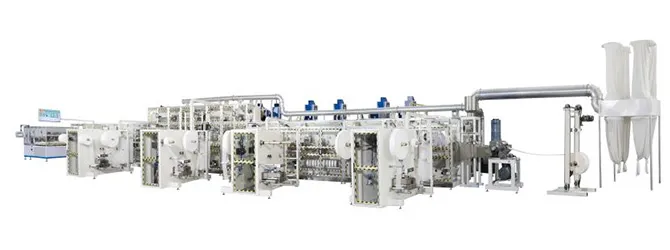
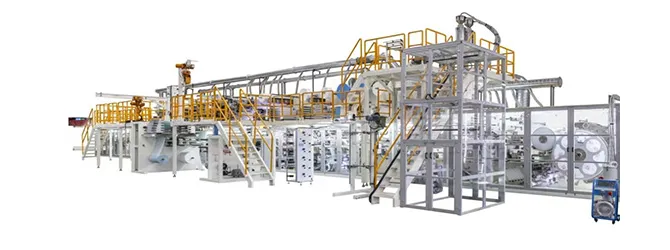
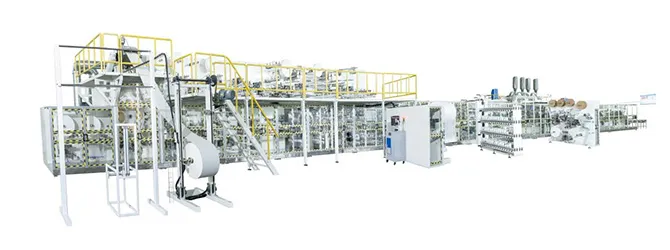
For a useful comparison, measure acceptable diapers produced over a full shift together with material consumption, rejects and stoppages. A higher design speed alone does not show how much saleable output a factory will obtain. DanE’s baby diaper production lines have different product configurations and output specifications that should be matched to the intended diaper.
Equipment purchase price is a factory investment, while depreciation allocates that investment over production. For the costs involved in purchasing a line, see How Much Does a Diaper Machine Cost?
Do Newer Diaper Materials Reduce Manufacturing Cost?
Newer diaper materials reduce manufacturing cost only when their total usage and production performance offset their purchase price.
Thin cores with a higher SAP-to-fluff ratio can change the quantities of SAP, pulp, core wrap and adhesives required. Lower-weight nonwovens can also change material spending, but they must still meet the diaper’s strength, softness and leakage requirements. Price the complete revised design and test its absorbency, dryness and rejection rate before calculating any saving.
How Can a Factory Calculate Its Own Cost Per Diaper?
A factory can calculate its cost per diaper by combining supplier material prices, measured consumption, packaging costs and monthly factory expenses, then dividing by acceptable output.
Prepare a separate calculation for each diaper size and design. Use production trials to record actual running time, trim, rejected products and packed output. Update the cost when material prices, product specifications or line performance change.