
How Much Does a Diaper Machine Cost?
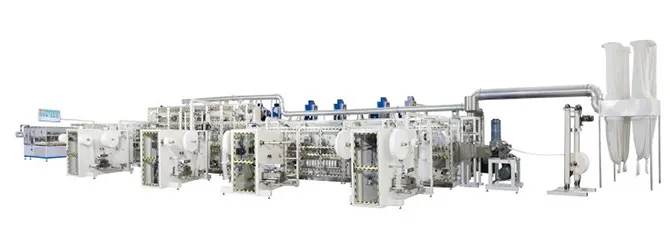
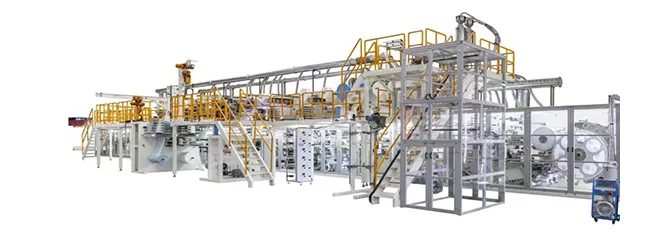
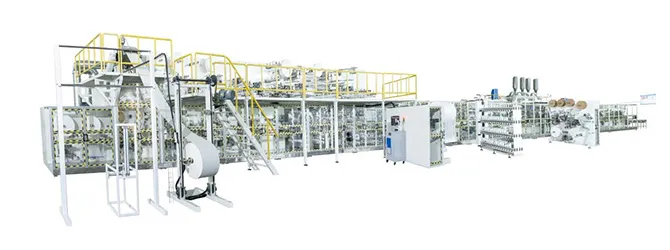
For initial budgeting, allow roughly US$200,000–US$2 million or more for a new industrial diaper production line. Some entry-level offers are below US$200,000, while premium, highly customized projects may require several million dollars. The final price depends on the diaper design, sustained production speed, component quality, manufacturing precision and equipment included.
This covers production equipment. Packaging, utilities, installation and startup materials may require separate budgets.
What Price Range Should You Budget for a Diaper Machine?
The following ranges provide a starting point for comparing equipment options.
| Equipment or project level | Indicative equipment budget, USD | What to verify |
|---|---|---|
| Low-price advertised configurations | About $50,000–$150,000 | Whether the offer covers a complete converting line, its condition, supported product design and excluded equipment |
| Standard industrial automatic configurations | About $200,000–$800,000 | Actual running speed, drive arrangement, splicing, inspection, tooling and packaging scope |
| More extensively equipped or specialized lines | About $800,000–$2 million or more | Core technology, pants or adult product requirements, automation and component specifications |
| Premium customized production projects | Several million dollars may be required | Product specifications, performance commitments, engineering requirements and delivery scope |
Prices are indicative and vary with product specifications, equipment scope and delivery terms. The ranges overlap because speed alone does not determine machine cost.
A diaper bagging machine packages finished diapers, while a converting line manufactures them from incoming materials. Make sure the quotation covers the equipment needed to produce your intended diaper, rather than only one part of the process.
Also check whether a quoted line ends at folding, includes a stacker, or delivers counted and sealed retail packs. These configurations require different investment levels.
Why Can Similar Diaper Machines Have Such Different Prices?
Two suppliers may advertise the same speed and both describe their machines as fully automatic. Their prices can still differ substantially because the specifications behind those descriptions are different.
The main differences include:
- Product construction: Open baby diapers, elastic-waist pants and adult briefs require different processing arrangements.
- Sustained output: Maximum design speed does not establish how much acceptable product the line will deliver over a shift.
- Manufacturing quality: Material grades, heat treatment, machining accuracy and assembly affect stability and wear.
- Process control: Core dosing, web tension, adhesive application and defect rejection can have different levels of precision.
- Supply and support: Tooling, packaging, commissioning, spare parts and service may be included or priced separately.
A meaningful price comparison starts with the same product specification, equipment scope and production requirements.
Which Machine Sections Make the Biggest Difference to Cost?
A diaper production line contains several linked processes. The quality and configuration of each section influence both the initial investment and daily production.
| Machine section | Specifications that can increase purchase cost | Effect on production |
|---|---|---|
| Material unwinding and splicing | Driven unwinds, tension feedback, web guiding and automatic splicing on more material positions | More consistent feeding and fewer interruptions during roll changes |
| Pulp preparation and core forming | Mill design, forming drum accuracy, controlled airflow and precise SAP dosing | More repeatable core weight, shape and absorbent material distribution |
| Core wrapping, compression and channel formation | Dedicated tooling, registration control and a validated bonding process | Stable core integrity and repeatable product construction |
| Elastic, cuff and ear application | Controlled elastic stretch, synchronized cutting and accurate transfer units | More consistent fit, cuff position and attachment |
| Adhesive application | Metered delivery, temperature control, suitable nozzles and monitored patterns | Reliable bonding with controlled glue consumption |
| Rotary cutting and final separation | Tool material, edge geometry, precision grinding, bearings and adjustment systems | Clean cuts, longer useful tool life and fewer cutting-related stops |
| Pants side-seam bonding | Suitable ultrasonic or thermal systems, patterned tooling and process control | Repeatable seam strength without excessive material damage |
| Inspection, rejection and packing interface | Camera coverage, tracking logic, verified reject timing and coordinated product handling | Reliable removal of specified defects and smoother downstream handling |
Core Forming and Absorbent Material Distribution
For a fluff-pulp core, the machine must fiberize pulp, feed superabsorbent polymer (SAP), form the core and transfer it without disrupting its structure.
Differences in the mill, airflow system, forming screens, dosing equipment and sealing can affect core consistency. Two cores with the same average weight may still have different material distribution.
Uneven distribution can create areas with insufficient absorbent material or inconsistent thickness. Accurate dosing and stable forming help manufacturers control the product recipe without relying on unnecessary material additions.
Ask the supplier to demonstrate core weight variation, SAP distribution and performance with your intended recipe. If you plan to use a preformed composite core, confirm which forming equipment is replaced or unnecessary.
Cutting Tools and Precision Grinding
A cutting unit can use different tool materials and construction methods. Suitable hardened tool steel and tungsten carbide have different purchase costs, wear characteristics and servicing requirements.
Tungsten carbide cutters generally have a higher initial cost than steel cutters. Their wear resistance can be valuable in demanding cutting applications, while precision grinding helps achieve the required cutting-edge geometry and accuracy.
The complete cutting assembly also matters. Bearings, shaft rigidity, cutter alignment and clearance adjustment influence cutting performance.
Ask about cutter and anvil specifications, expected service conditions, regrinding options, replacement cost and delivery time.
Adhesive Application and Side-Seam Bonding
Hot-melt adhesive systems differ in dosing control, temperature stability, application patterns and elastic-handling capability. These differences can influence bond quality, glue usage and cleaning requirements.
Poorly controlled application may require frequent adjustment or additional adhesive to maintain the required bond. A suitable system should deliver the specified pattern consistently across the agreed operating range.
For pants side seams, the ultrasonic or thermal system must work with the actual material stack. In ultrasonic bonding, tooling geometry and control of the working gap matter as well as generator power.
Production trials should establish seam strength and consistency at the agreed running speed.
How Do Machine Materials and Manufacturing Precision Affect Price?
Some of the most meaningful differences are inside the machine. A painted frame and stainless-steel covers reveal little about shaft alignment, bearing fits or cutting accuracy.
Frame Materials and Structural Design
Frame section sizes, plate thickness, support layout and mounting interfaces affect rigidity and access for maintenance. A well-designed frame helps processing units maintain alignment during operation.
For welded structures, the manufacturer needs to control welding distortion and residual stress before final machining. Where stress relief is required by the design, it adds processing time and cost.
Weight alone does not prove quality. Structural design, dimensional verification and stability during production are more useful indicators.
Shafts, Rollers and Bearing Housings
Shafts and rollers may require selected steel grades, heat treatment, precision turning and grinding. Bearing housings need suitable dimensional tolerances and surface finishes.
These choices affect shaft runout, bearing seating, roller alignment and wear. At production speed, errors can appear as vibration, uneven pressure, web movement or repeated adjustment.
For example, an inaccurately machined roller may create uneven contact across the material width. A poorly controlled bearing fit can affect alignment and bearing service life.
Request the critical material specifications and inspection records relevant to these assemblies. A general description such as “high-quality steel” does not provide enough information for comparison.
Machining Equipment and Inspection
Large CNC machining centers can machine frame reference surfaces and mounting positions. Precision lathes and grinders produce rotating parts, while measuring equipment checks whether the results meet the drawings.
The machining equipment used to make the parts is one part of the manufacturing process. Suitable fixtures, process control, calibrated measurement and final inspection determine whether finished components meet their specifications.
Useful inspection records include roller runout, mounting-surface alignment, bearing fits and cutting-unit geometry.
Heat Treatment, Surface Treatment and Assembly
Hardening and tempering can provide specified wear resistance and toughness for appropriate parts. Surface treatments may improve corrosion resistance, wear behavior or release properties where needed.
More hardness is not automatically better. An unsuitable combination of material, treatment and loading can increase cracking or failure risk.
Final assembly also takes time. Processing units need alignment, working gaps need adjustment, and appropriate rotating assemblies may require balancing. Lubrication, drive synchronization and operation must then be checked.
These manufacturing and assembly steps contribute to the selling price even when two machines look similar.
Does Stainless Steel Justify a Higher Machine Price?
Stainless steel can justify additional cost where corrosion resistance, cleaning or material-contact requirements call for it. It does not establish the overall quality of the line.
Frames, guards, rollers, shafts and cutting tools perform different jobs and may need different materials.
Ask which parts are stainless steel and which grades are used. Material selection should suit the function of each component.
How Much Do Automation and Product Design Change the Cost?
Full Servo Versus Semi-Servo
A full-servo configuration can provide more independently controlled motion and flexible synchronization. Its price depends on the number and specification of controlled axes, the motion-control architecture and the software.
To compare full-servo diaper machine prices, ask which units are servo-driven and how tension control, registration and changeovers operate.
The control system, mechanical design and software need to work together to deliver consistent production. The same motor or PLC brand does not make two production lines equivalent.
Automatic Splicing and Inspection
Automatic splicing requires additional unwinding equipment, controls and material-handling mechanisms. Its value depends on which material positions are covered, how often rolls change and how much splice-related waste is generated.
Confirm whether automatic splicing is available for all relevant materials or only selected positions.
Vision inspection also needs a defined scope. A camera system that checks tape position does not automatically detect core distribution problems or measure absorbency.
Specify the defects to be detected, the acceptance criteria and how reject tracking is verified.
Open Diapers, Pull-Up Pants and Adult Products
Pull-up pants generally require additional elastic-lamination, product-handling and side-seam processes compared with a simpler open-diaper design.
Adult products can require wider webs, larger cores and different handling arrangements. These requirements influence machine dimensions, tooling, drive loads and material consumption during trials.
However, there is no universal price order. A premium open-diaper line can cost more than a basic pants line.
Thin cores, channels and specialized waistband designs also need a defined process. Specify the intended structure and materials before asking a supplier to price a feature such as a channel core.
What Costs Should You Budget for Beyond the Machine?
Before comparing totals, ask each supplier to identify what is included.
| Cost item | What to confirm |
|---|---|
| Stacking and packaging | Stacker, compression, bagging, coding and downstream handling |
| Utilities | Electrical distribution, compressed air, vacuum, dust extraction and any required cooling |
| Change parts and tooling | Included sizes, forming tools, cutters, guides and additional size kits |
| Delivery and installation | Shipping terms, insurance, unloading, positioning, travel and commissioning charges |
| Startup materials and testing | Trial rolls, adhesive, pulp, SAP, packaging materials and product testing |
| Maintenance and spares | Initial spare-parts package, consumables, special tools and service terms |
| Working capital | Material inventory, wages and operating expenses before customer payments arrive |
Factory premises, local approvals and destination-specific charges need separate consideration.
If one quotation includes packaging and commissioning while another covers only the converting machine, compare the cost to reach the same operating condition.
How Can You Compare Real Output and Operating Cost?
Calculate Saleable Production
Use a consistent calculation:
Saleable output = Running speed × Scheduled time × Running-time fraction × Good-product yield
For example, assume two machines both run at 500 pieces per minute during a scheduled eight-hour shift:
| Assumption or result | Line A | Line B |
|---|---|---|
| Running speed | 500 pcs/min | 500 pcs/min |
| Scheduled time | 480 minutes | 480 minutes |
| Running-time fraction | 80% | 90% |
| Good-product yield | 97% | 99% |
| Saleable output | 186,240 diapers | 213,840 diapers |
Illustrative comparison based on the assumptions above.
Under these assumptions, Line B produces 27,600 more acceptable diapers per shift despite having the same running speed.
Use clearly defined data. If an overall equipment effectiveness (OEE) figure already includes availability, speed losses and quality losses, do not apply those losses again.
Compare Cost per Thousand Acceptable Diapers
Include materials consumed, labor, utilities, maintenance and an allocation for equipment ownership and financing.
Cost per 1,000 acceptable diapers = Total production cost ÷ Acceptable diapers produced × 1,000
Small unit-cost differences become meaningful at volume. A saving of $0.001 per diaper equals $100,000 at 100 million diapers per year.
The financial benefit depends on achieving the expected production volume and selling the output. Evaluate savings from reduced waste, controlled glue usage, longer tool life and fewer stops under comparable operating conditions.
What Should You Request Before Comparing Quotations?
Give each supplier the same specification:
- Product: Open diaper or pants, baby or adult, size range and target samples.
- Construction: Core recipe, materials, cuffs, elastics, ears, tapes and any channels.
- Output: Required sustained speed for each size and expected shift production.
- Equipment scope: Converting, stacking, packaging, utilities and change parts.
- Acceptance criteria: Trial duration, raw materials, quality limits, waste definitions and treatment of stops.
- Support: Commissioning, training, warranty, critical spares and service arrangements.
Request a factory acceptance test with representative materials and an agreed product specification.
The test should include relevant operations such as roll changes, rejection and size changeovers, with results recorded under defined conditions. This provides a clearer basis for evaluating the quotation than a short demonstration at maximum speed.
Frequently Asked Questions
Can I Buy a Complete Diaper Machine for Under $100,000?
Some suppliers advertise diaper machines below $100,000, but the listing price alone does not establish a complete, production-ready installation. Verify the equipment condition, product structure, sustained output, included systems and additional costs.
Why Are Premium Diaper Machines More Expensive?
Premium machines may include more advanced processes, precision tooling, automation, engineering and production support. Their value should be demonstrated through suitable product capability, repeatable quality, maintenance performance and acceptable output.
Is a Used Diaper Machine a Better Investment?
A used line can reduce the purchase price if its condition and product capability match your requirements. Budget for dismantling, transport, refurbishment, tooling, controls and commissioning. Check component availability and inspect the line under power where possible.
Can One Machine Make Baby Diapers, Adult Diapers and Pull-Up Pants?
Not usually without substantial engineering changes or a platform specifically designed for that flexibility. Differences in product dimensions, core handling, elastic application and side seams can require dedicated equipment. Confirm the supported products in writing.
Does a Higher-Speed Machine Always Have a Lower Production Cost?
No. A faster machine lowers unit cost only when its output, quality, running time and sales volume justify the investment. Compare expected acceptable production and operating costs for your product mix.