
What Raw Materials Are Used to Make Diapers?
Baby diapers use nonwovens, fluff pulp, SAP, tissue wrap, PE backsheet film, elastics, fasteners, and adhesives to absorb liquid and prevent leaks.
The topsheet and acquisition layer move liquid away from the skin. Fluff pulp and superabsorbent polymer (SAP) absorb it, while the backsheet, leak guards, and elastic openings help keep it inside the diaper. The exact material combination depends on whether the product is a taped diaper or pull-up pants.
Which Raw Material Is Used in Each Diaper Layer?
The skin-facing layers use liquid-permeable nonwovens, the absorbent core uses fluff pulp and SAP, and the outer layers use a liquid-barrier film and materials that improve fit.
| Diaper component | Common material | What it does | Where it is used in production |
|---|---|---|---|
| Topsheet | Soft polypropylene (PP) nonwoven, sometimes blended with polyethylene (PE) or other fibers | Lets liquid pass away from the skin | Topsheet unwinding and lamination |
| Acquisition and distribution layer (ADL) | Porous synthetic or cellulosic nonwoven | Receives liquid and spreads it across the core | ADL cutting and placement |
| Absorbent core | Fluff pulp and SAP, or an engineered composite core | Absorbs and retains liquid | Pulp defibration, SAP dosing, and core forming |
| Core wrap | Tissue or suitable nonwoven | Contains the pulp and SAP and helps the core stay intact | Core wrapping |
| Backsheet | Liquid-barrier film, commonly PE, often laminated to an outer nonwoven | Stops liquid from reaching clothing | Backsheet unwinding and lamination |
| Standing leak guards and leg cuffs | Liquid-resistant nonwoven and elastic strands | Helps contain liquid at the leg openings | Cuff formation and elastic application |
| Fastening and waist components | Elastic panels, hook-and-loop materials, or other fastening materials, depending on the diaper design | Keeps the diaper fitted and closed | Panel, tab, waistband, or side-seam assembly |
| Bonding materials | Hot-melt adhesives | Attaches layers, elastics, and other components | Adhesive application |
A diaper may also contain a wetness indicator, printed material, or a skin-contact lotion. These are optional features, not materials required in every diaper. Packaging bags and film are separate from the materials that make up the diaper itself.
How Do Fluff Pulp and SAP Work Together?
Fluff pulp receives and distributes liquid through the absorbent core, while SAP absorbs and retains that liquid, including when pressure is applied to the diaper.
Fluff pulp is wood-derived cellulose supplied as sheets or bales for diaper manufacturing. In a conventional production line, the pulp is separated into fibers before the core is formed. The fiber structure helps liquid reach more areas of the core instead of remaining in one spot.
SAP is usually supplied as granules of cross-linked sodium polyacrylate. The granules swell when they absorb liquid and help keep moisture from returning to the surface. An ADL above the core moves liquid into it; a tissue or nonwoven wrap around the core helps keep the pulp and SAP contained.
More SAP does not automatically mean better absorption. A suitable grade must take in liquid quickly, retain it under pressure, and allow subsequent liquid to move through the swollen core. Manufacturers therefore compare SAP absorption speed, capacity, absorption under load, and permeability rather than choosing a grade by its maximum absorption figure alone.
Why Does a Diaper Use Different Types of Nonwoven?
A diaper uses liquid-permeable nonwoven on its inner surface, liquid-resistant nonwoven in its standing leak guards, and soft nonwoven on many outer covers because these parts have different jobs.
Polypropylene is naturally water-repellent, so a PP topsheet is commonly given a hydrophilic finish to help liquid pass through it. The standing leak guards need the opposite property: they resist liquid flow near the diaper’s edges. The outer-cover nonwoven mainly gives the backsheet a softer, cloth-like feel.
Softness alone cannot establish whether a topsheet works well. Its liquid strike-through and rewet performance should be checked in the assembled diaper. Likewise, a liquid-resistant cuff should be tested in its finished position, with the specified elastic tension and bond strength.
What Is the Backsheet Made Of?
A diaper backsheet usually contains a PE-based liquid-barrier film, often laminated to an outer nonwoven that makes the diaper feel softer.
Some backsheet films are designed to allow water vapor to pass while still blocking liquid. “Breathable” therefore does not mean that urine should pass through the film. Manufacturers need to check the film’s liquid-barrier integrity, thickness, width, and, when relevant, water-vapor transmission. Pinholes or damage during converting can cause leaks even when the original film meets its specification.
What Materials Keep a Diaper Fitted and Closed?
Elastic strands hold the leg and waist openings against the body, fastening components close taped diapers, and adhesives keep these materials attached during use.
Taped diapers commonly use side tabs and a frontal landing area, often with elastic ears to improve fit. Pull-up pants use an elasticated waist and joined side seams instead of a refastenable waist closure. Some pants also include a tape for securing the diaper after use.
Hot-melt adhesives serve different purposes within one diaper. Construction adhesive bonds layers, elastic-attachment adhesive holds stretched strands in place, and some core designs use a dedicated adhesive to help the absorbent material remain stable when wet. Changing an adhesive requires checking its bond strength and compatibility with the specific nonwoven, film, or elastic it will contact.
Do Taped Diapers and Pull-Up Pants Need Different Raw Materials?
Taped diapers and pull-up pants share the main absorbent materials, but pants require more extensive elastic waist materials and side-seam construction, while taped diapers require tabs, ears, and a landing area.
The distinction affects both the material list and the equipment configuration. Two products may use the same pulp and SAP but require different nonwoven widths, elastic quantities, panel handling, and bonding methods. The product structure should be decided before finalizing material specifications or selecting a production line.
Are Newer Diaper Materials Available?
Current alternatives include non-bleached fluff pulp, lower-footprint SAP grades, and cellulosic nonwovens, but each must be evaluated for both diaper performance and production compatibility.
- Non-bleached fluff pulp: Stora Enso’s NaturaFluff Eco is a naturally beige pulp for hygiene products. Stora Enso reports a 20% lower product carbon footprint than its bleached pulp equivalent. A manufacturer still needs to check how the pulp processes and whether its color suits the finished product.
- Lower-footprint SAP: BASF introduced HySorb B 6610 ZeroPCF in 2025. BASF reports a zero product carbon footprint under its stated calculation method and describes the grade as a direct replacement that needs no diaper-line adaptation. This does not mean the finished diaper has zero emissions or that the SAP is biodegradable.
- Cellulosic nonwovens: ANDRITZ presented baby-diaper prototypes using cellulosic spunlace material in 2025. These prototypes show a possible material direction, but replacing an existing topsheet still requires tests for liquid transfer, web strength, feeding, and bonding.
Plant-derived content should not be used as proof that an entire diaper is biodegradable. The film, SAP, elastics, adhesives, and other components must also be considered before making a claim about the finished product.
What Specifications Should Manufacturers Check Before Buying Diaper Raw Materials?
Manufacturers should confirm each material’s dimensions, functional properties, and roll or supply format against the intended diaper design and production line before approving a supplier.
| Material | Specifications to confirm | What a mismatch may cause |
|---|---|---|
| Nonwoven, ADL, and core wrap | Width, basis weight, strength, liquid-handling properties, roll diameter, core diameter, and winding direction | Wrinkles, web breaks, incorrect placement, or poor liquid transfer |
| SAP | Particle-size distribution, moisture, absorption speed, capacity, absorption under load, and permeability | Unstable dosing, dust, slow uptake, or high rewet |
| Fluff pulp | Supply form, moisture, and performance during defibration | Lumps, excessive dust, or uneven core formation |
| Backsheet film | Width, thickness, liquid-barrier integrity, and water-vapor transmission if a breathable film is specified | Web breaks, pinholes, or leakage |
| Elastics and adhesives | Elastic stretch and recovery; adhesive application temperature, viscosity, and bond compatibility | Loose cuffs, detached elastics, or weak layer bonds |
A replacement material should also pass a trial on the intended diaper structure at the agreed operating speed. The trial should check core weight and SAP placement, web alignment, bond strength, and elastic recovery. Finished diapers should be tested for liquid intake, rewet, and leakage after repeated liquid applications. A raw material’s laboratory result alone cannot confirm how the complete diaper will perform.
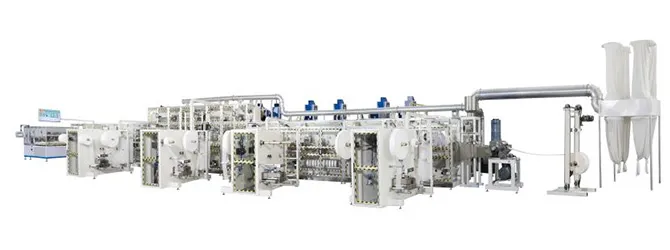
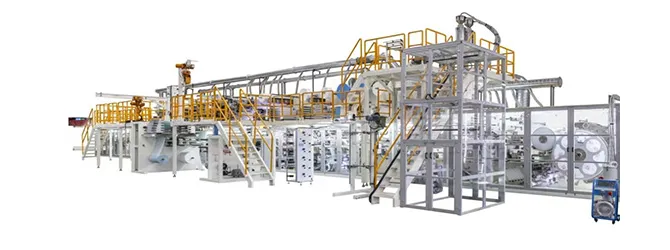
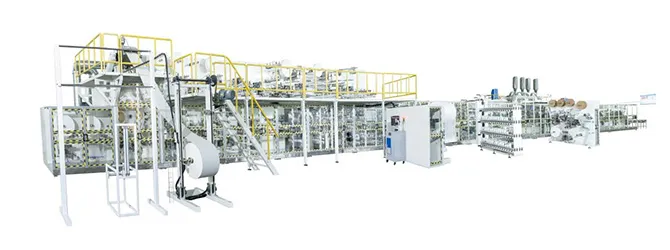
DanE’s baby diaper machines process fluff pulp, SAP, nonwovens, PE film, elastics, and hot-melt adhesives. The material specifications, finished diaper structure, and machine configuration should be confirmed together before production.
Are Disposable Diapers Made of Cotton?
Most disposable diapers are not made primarily of cotton; they use nonwovens, absorbent core materials, barrier film, elastics, and adhesives, although cotton may appear in a selected component.
A soft or “cotton-like” topsheet does not establish its fiber content. Anyone comparing finished diapers should check the material disclosure for that specific product rather than relying on how the surface feels.